Monthly Shorts 2/22
One Year Anniversary

Economics
It’s hard to remember now, but once upon a time part of the argument for patenting was that the public would be able to understood what the new technology did. Because the patent would have the steps to replicate it. How plausible is that today? Patents are trivial or, as in the case of Theranos, impossible for the holder to achieve, and merely held against anyone else who might want to actually create something.
On the other hand …I’ve never heard the EFF referred to as an “industry lobbyist” before, and I’m not quite sure how to handle it. For context, they were formed in response to a combination of truly impressive levels of governmental incompetence and malice (though recently they’ve shifted, with the political winds, towards greater skepticism of large tech companies: they have always fought for freedom, and I have always respected them). As you might predict, the author is taking a firm opinion against the EFF’s, because the author is defending the existing patent regime, and doing so interestingly. Recommended, if partially because I rarely find anyone defending the existing patent regime.
Coolest paper I’ve found this month goes to a study that looks at the value of hierarchy in video game production, finding that flatter hierarchies produce higher ratings but more vertical hierarchies produce more sales. Now, of course, until it replicates, it should not be trusted. Still! Nifty! Confirms my preconceptions!
It turns out that the AI is at it again. Competitive programming problems and math olympiads.
Interesting piece on why journalists are willing to pay so much to live in Brooklyn.
Geopolitics
I am allowing myself a single entry from the Olympics, which even writing on the 9th I can say are dealing with both controversy (it’s not just Chinese extremely questionable calls! The Russians are, unsurprisingly, doping without meaningful consequence) and a surprising degree of apathy. Admittedly, how do I watch them: pay extra for some service I’ve never used before and will never use again? Not very appealing. Still, this dance on ice was very pretty and fun. OK, I lied, this one is also amazing, as it will remind you that ice dance is ballet dancers, who are already inhuman, dancing while constantly running around with knives on their feet.
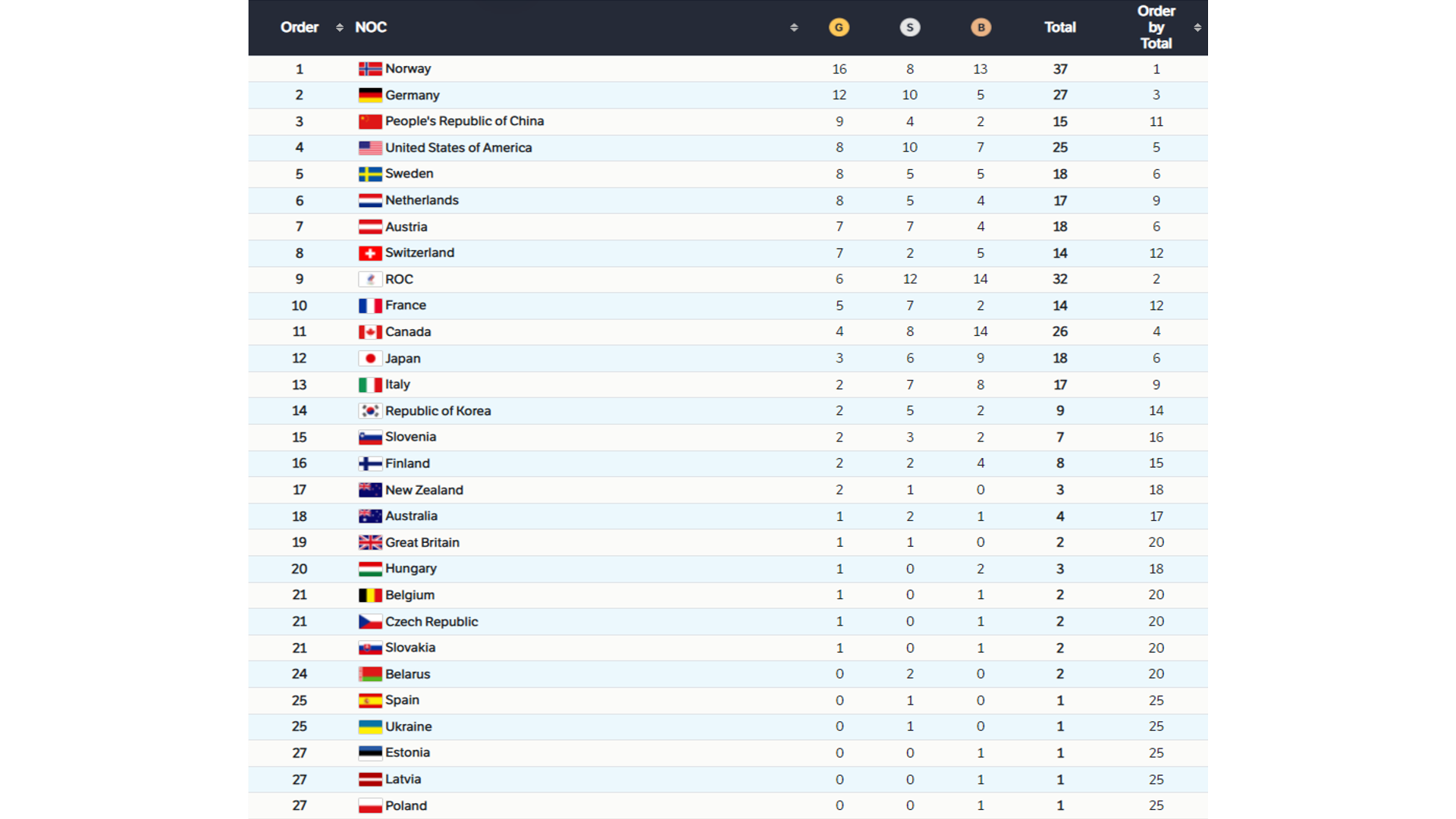
Incidentally, the results of the Olympics surprised me, were interesting in several respects, and were utterly overshadowed by what happened afterwards. Overall, I’m inclined to call them a very bad Olympics for the IOC, a poor one for China, and an impressive success for Norway (first by both total medals and golds).
The most, shall we say, statistically surprising result is that China eked 9 golds out of 15 medals. The majority of its medals were golds. The only other country for which this is true is New Zealand, with two gold medals and a silver. It is one thing to argue over individual questionable ref calls. Another to note that, if a Chinese athlete made it to the top three, they were probably going to get the gold medal.
Feb 14: I’ve been pretty successful at ignoring Ukraine! Last month I recommended reading a history of Russia, or the Ukraine. For fun linguistic reasons that used to be regarded as the correct phrasing, and using it marked you as a serious foreign policy person. These days it just marks you as out of touch if you’re still using it, and has for at least the past five years. My grounds were pretty simple: you’d spend less time, be less stressed, and know more afterwards. Westwind argues it more eloquently here. This month, I still recommend ignoring the looming possible threat of war between nuclear-armed states. You know, if possible.
Feb 28: Two weeks later, I think it’s safe to say that I have not been ignoring Ukraine. What is there to say? I am horrified. I’m confused. Understanding The War In Ukraine, by historian Brett Deveraux, is highly recommended.
Brendan O’Regan sounds like A Character. Fight imperialism and colonialism through capitalism! And I’d argue it (mostly) worked for England: contrast her other colonies given freedom around the same time! Anyways, that link has more on him, and why we have duty-free zones in airports.
The China Initiative is worth reading from a policy analysis perspective. The goal was to identify scientists stealing secrets for the CCP. The mechanism was to prosecute Chinese-descended scientists who made technical mistakes on grant application forms. A large outcome was to decrease US-Chinese collaboration in science. It seems likely that the problem was the link between the mechanism and the goal, and in particular the part where prosecutors went after the easiest targets who looked like they met the goal.
Research and Exploration
Research as a Stochastic Decision Process, for a professional researcher, seems like the sort of paper that, if you read it with the right time and right mindset, could double your productivity. By the same author, I expect my audience might enjoy A Fervent Defense of Frequentist Statistics.
As a new manager, I asked for and received advice. One piece that I am following is that the process of doing research is very different from the report or presentation that you will end up with, and it’s important and useful to do both simultaneously. The thing is, nobody will care about your spreadsheet! Bryan Caplan wrote an incredibly provocative work, and almost nobody has even looked at the quantification behind his bold claims. So why do it? “Character is the difference between your incentives and your actions.” And in the long run, if your research is shoddy, you will not be accepted by sound crafters as a fellow.
How to actually “git gud” from someone who threw Dark Souls in the garbage twice is simultaneously an advertisement for the game, a useful explanation of a good attitude towards games in general, and a generally useful life framework for problems where failure is free. Which is not all of them! But I think many people, particularly when stuck, “try harder” too much and experiment without expectation of winning this time too little. For a general-case treatment of the problem, there’s a nice large area of mathematics and computer science devoted to solving the tractable portions.
Continuing my theme of understanding all of life through dance metaphors, I really liked Malcolm Ocean’s metaphor of building trustworthiness as dancing. It’s on my mind because I’m now managing people, and feel wildly underqualified for it.
The Plausibly Deniable Database does what cryptocryptography should: make hidden files that it is hard or impossible to prove exist. Right now, if you poke around a file system, most defenses still reveal that there is hidden information, and clever tricks like fake passwords that get you into different portions are almost non-existent. This is still early stages, but I’m optimistic.
Meta
This is the one-year anniversary of Neon Dawn. I don’t have many subscribers, but I really appreciate the ones I have. I’ve written 12 monthly links, and one piece of original writing, on Aaron Swartz’ suicide at 26. I’m going to aim for posting one original piece of writing a month from now on, done in the style of my other links.
This month’s is a rewrite of an interesting Twitter thread, because I tend to think that Twitter threads are one of the worst methods of presenting information and play to many of our worst biases. It was written before the cutoff of Russia from SWIFT, which is orders of magnitude larger but of essentially a similar character.